Wind it once and it keeps going, for as long as you keep wearing it. The automatic movement is the oldest idea in modern watchmaking, and it is still the reason a good mechanical watch feels alive in a way no battery ever will. Here is what is turning under the dial of the Meridian 01, in plain language.
The thirty second version
- A weighted rotor spins as your wrist moves and winds a coiled spring for you.
- That spring releases its energy slowly through a train of tiny gears.
- A balance wheel ticks back and forth to portion out the time, roughly six beats a second.
- No battery is involved at any point, which is exactly why owners keep them for decades.
No battery, and that is the whole point
A quartz watch is a small computer. A tiny battery pushes current through a quartz crystal, the crystal vibrates at a fixed rate, and a circuit counts those vibrations and nudges the hands once a second. It is accurate and it is cheap, and in a few years the battery dies and the whole thing gets thrown in a drawer.
An automatic watch does not count anything. It measures time the way a pendulum clock does, mechanically, using only springs, gears and the motion of your own wrist. Nothing runs out. Nothing needs replacing on a schedule. Looked after, a mechanical movement can run for a lifetime and then run for the next person too. That difference is easy to feel the moment you pick one up: the weight in the hand, the soft sweep of the seconds, the sense that something is genuinely working in there.
The rotor: your wrist becomes the power source
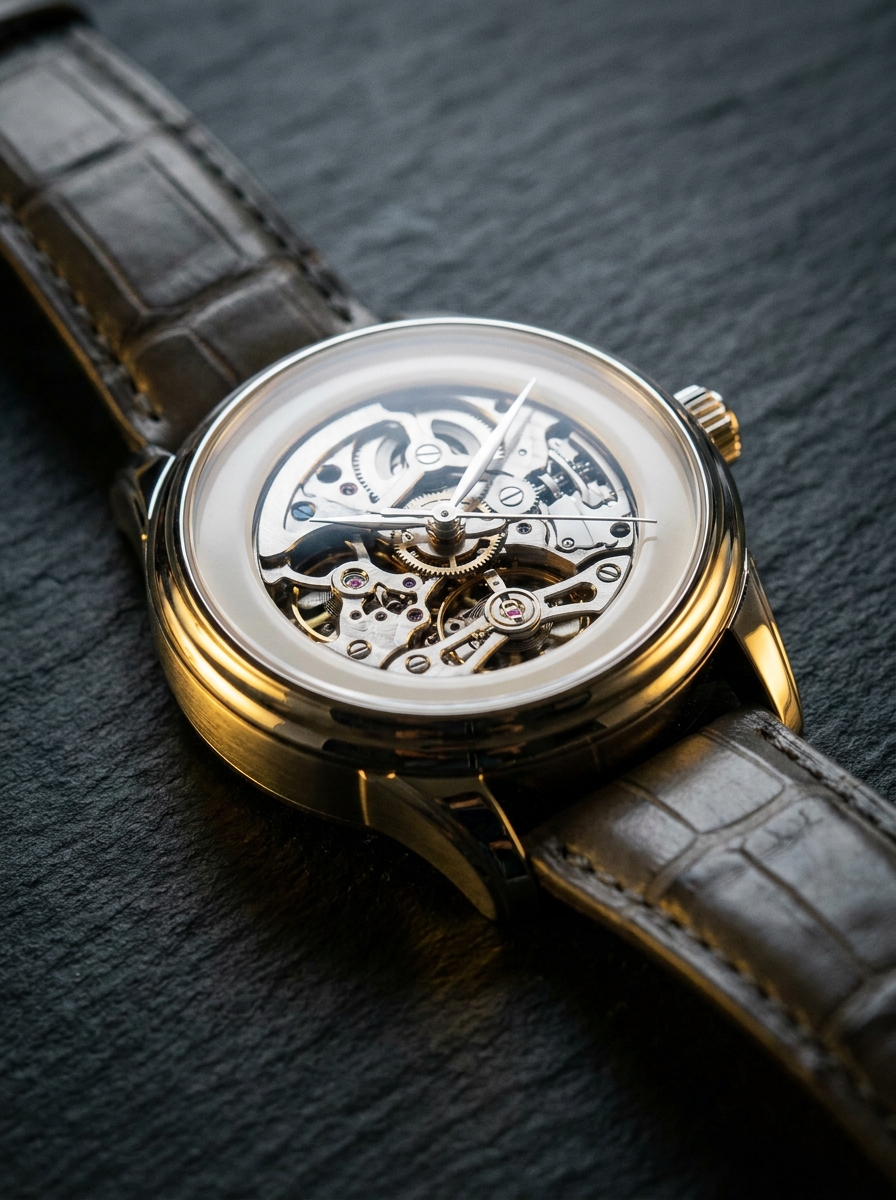
The gold weight sweeping across the movement above is the rotor. It is a half disc, heavier on one side, pivoted at the centre so it can swing freely. Every time you move your arm, gravity pulls the heavy edge downward and the rotor turns. Through a small set of gears, that rotation winds the mainspring for you, quietly, all day long. This is the whole trick that makes a watch automatic, or self winding: you do the winding without ever thinking about it.
Set the watch down overnight and it slowly relaxes. Pick it up and give it a shake, or simply put it on and go about your day, and within a minute it is running again. The Meridian 01 holds roughly forty hours of reserve once it is wound, so a watch worn Friday will still be ticking come Sunday brunch.
A quartz watch measures time. An automatic keeps it, using nothing but the way you move.
From the Meridian workshopThe mainspring: a coil that remembers the day
All of that motion has to be stored somewhere. It is stored in the mainspring, a long flat ribbon of hardened alloy coiled tightly inside the barrel, the toothed drum near the top left of the movement. Winding the rotor tightens the coil. Left alone, the coil wants to unwind, and it is that steady, patient pull that powers everything downstream.
The clever part is restraint. If the mainspring simply let go, the watch would blur through a whole day in seconds. Instead its energy is released a sliver at a time, handed from wheel to wheel across the gear train, each one turning a little faster than the last, until it reaches the part that sets the pace.
The balance wheel: the heartbeat you can hear
The wheel oscillating at the lower left is the balance, and it is the soul of the watch. Paired with a fine hairspring, it swings back and forth at a fixed rhythm, on the Meridian 01 close to six beats every second. Each swing releases the gear train by one precise step, then locks it again. That endless lock and release is the ticking you hear when you hold the caseback to your ear, and it is what turns a barrel of stored energy into hours, minutes and seconds you can trust.
Getting that rhythm exactly right is the craft. Every Meridian movement is regulated and timed over several days on a machine that listens to its beat, then adjusted by hand until it keeps time to within a tight daily tolerance before it is allowed to leave the workshop.
What an automatic gives you that a battery cannot
- A living seconds hand. Not a once a second jump but a smooth, sweeping glide, the clearest sign there is a real movement inside.
- Nothing to replace. No battery, no annual trip to a counter, no dead watch waiting in a drawer.
- A machine that can be serviced. Cleaned and oiled every few years, a good movement simply carries on, for decades.
- A caseback worth engraving. A date, an initial, a few words, turning an object into a record you can hand on.
- Weight and sound that feel like value. The heft in the hand and the soft tick are things a screen has never managed to fake.
Why we built the Meridian 01 around an automatic
We could have fitted a quartz module. It would have cost less, kept marginally tighter time, and asked nothing of the wearer. We chose a mechanical automatic anyway, because a watch you intend to pass on should be alive on the inside, not counting down to a dead cell. The 24 jewel movement sits behind a box sapphire crystal, inside a 316L steel case rated to 10 ATM, brushed and polished by hand and backed for five years. It is the kind of watch that earns its place on a wrist and then earns a second owner.
Now that you know what is turning under the dial, the sweep of the seconds hand reads a little differently. It is not a feature. It is forty hours of your own movement, released one heartbeat at a time.